|
| Mother Jones (magazine) (Photo credit: Wikipedia) |
A
National Magazine Award winner from Mother Jones.
I started applying for jobs in private prisons because I wanted to see the inner workings of an industry that holds 131,000 of the nation’s 1.6 million prisoners. As a journalist, it’s nearly impossible to get an unconstrained look inside our penal system. When prisons do let reporters in, it’s usually for carefully managed tours and monitored interviews with inmates. Private prisons are especially secretive. Their records often aren’t subject to public access laws; CCA has fought to defeatlegislation that would make private prisons subject to the same disclosure rules as their public counterparts. And even if I could get uncensored information from private prison inmates, how would I verify their claims? I keep coming back to this question: Is there any other way to see what really happens inside a private prison?
CCA certainly seemed eager to give me a chance to join its team. Within two weeks of filling out its online application, using my real name and personal information, several CCA prisons contacted me, some multiple times.
They weren’t interested in the details of my résumé. They didn’t ask about my job history, my current employment with the Foundation for National Progress, the publisher of Mother Jones, or why someone who writes about criminal justice in California would want to move across the country to work in a prison. They didn’t even ask about the time I was arrested for shoplifting when I was 19.
Nothing about the way he got the job seems unethical to me. But this section near the end of the story is what fascinates:
I take a breath and try to remember who I am. Miss Carter is right. It is getting in my blood. The boundary between pleasure and anger is blurring. To shout makes me feel alive. I take pleasure in saying “no” to prisoners. I like to hear them complain about my write-ups. I like to ignore them when they ask me to cut them a break. When they hang their clothes to dry in the TV room, an unauthorized area, I confiscate the laundry and get a thrill when they shout from down the tier as I take it away. During the lockdown, when Ash threatened to riot, I hoped the SORT team would come in and gas the whole unit. Everyone would be coughing and gasping, including me, and it would be good because it would be action. All that matters anymore is action.
Until I leave. When I drive home, I wonder who I am becoming. I feel ashamed of my lack of self-control, my growing thirst for punishment and vengeance. I’m getting afraid of the expanding distance between the person I am at home and the one behind the wire. My glass of wine with dinner regularly becomes three.
Mother Jones rationale:
In 1887, a 23-year-old journalist got herself checked into the Women’s Lunatic Asylum on Blackwell’s Island in New York City. When she emerged, she wrote about patients tied together with ropes, abusive staff and ubiquitous vermin, “lunatics” treated with nothing more restorative than ice baths, and, perhaps most disturbingly, patients who seemed to be perfectly sane, dumped there by a society that had few safety nets for women who were single, poor, and often immigrants.
Serialized by Joseph Pulitzer’s New York World, Nellie Bly’s accounts (later collected in a book called Ten Days in a Mad-House) caused a sensation, fueled in no small part by her pluck—she’d begun her career by writing a scathing rebuttal to an editorial titled “What Girls Are Good For”—though her ingénue looks couldn’t have hurt, either. But despite prose that shades purple to today’s ears, Bly’s work holds up not only for its daring, but for its impact: It prompted a grand jury investigation that led to changes she’d proposed, including a $26 million (in today’s dollars) increase to the budget of the city’s Department of Public Charities and Correction and regulations to ensure that only the seriously mentally ill were committed.
Access to prisons has been vastly curtailed. There is no way to know what truly happens inside but to go there.
Bly—who’d go on to get herself arrested so she could investigate conditions at a women’s prison, and to best Jules Verne’s fictional protagonist by circumnavigating the world in 72 days—was not the first journalist to go inside an institution to expose its inner workings. Or the last. Ted Conover also reported from behind prison walls, as did Ben Bagdikian, for whom MoJo’s fellowship program is named. In 1961, John Howard Griffin ingested a chemical that darkened his skin to investigate racial apartheid in the United States. Barbara Ehrenreich took jobs at chain restaurants and Walmart to spotlight the plight of low-wage workers. Mac McClelland worked as a picker in a warehouse of an online shipping behemoth to report for Mother Jones.
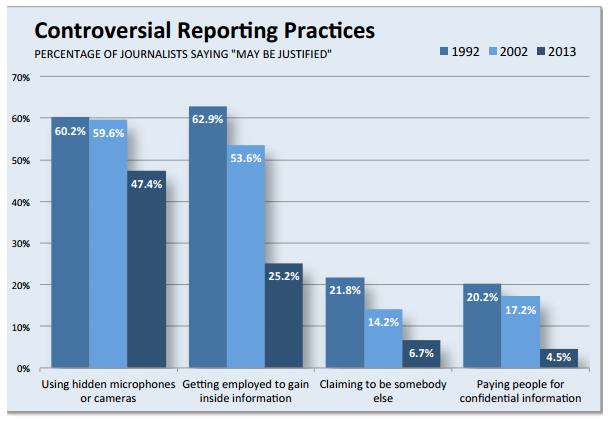
But while such investigations were commonplace in the muckraker era, they’ve grown increasingly rare. Why? First, there’s a real concern over ethics. When is it okay for reporters to not announce themselves as such? There’s no governing body of journalism, but a checklist written by Poynter ethicist Bob Steele provides guidelines for assessing when this kind of reporting is acceptable. I’ll paraphrase:
- When the information obtained is of vital public interest.
- When other efforts to gain that information have been exhausted.
- When the journalist is willing to disclose the reason and nature of any deception.
- When the news organization applies the skill, time, and funding needed to fully pursue the story.
- When the harm prevented outweighs any harm caused.
- After meaningful deliberation of the ethical and legal issues.
To see what private prisons are really like, Shane Bauer applied for a job with the Corrections Corporation of America. He used his own name and Social Security number, and he noted his employment with the Foundation for National Progress, the publisher of Mother Jones. He did not lie. He spent four months as a guard at a CCA-run Louisiana prison, and then we spent 14 more months reporting and fact-checking.
We took these extraordinary steps because press access to prisons and jails has been vastly curtailed in recent decades, even as inmates have seen their ability to sue prisons—often the only way potential abuses would pop up on the radar of news organizations or advocates—dramatically reduced. There is no other way to know what truly happens inside but to go there.
But here’s the other reason investigations like this one have grown so rare: litigation. When ABC News busted Food Lion for repackaging spoiled meat for sale back in 1992, a jury bought the company’s line that the real offense had been the falsification of employment applications and the reporters’ failure to fulfill their assigned duties—i.e., repackaging spoiled meat! The $5.5 million damage award was eventually knocked down to just two dollars, but it put a chill on this kind of muckraking for a generation, and during that time, corporate and official entities built an ever-tighter web of legal protections. Nondisclosure agreements—once mainly the provenance of people who work on Apple product launches and Beyoncé videos—are now seeping into jobs of all stripes, where they commingle with various other “non-disparagement” clauses and “employer protection statutes.” Somewhere along the way, employers’ legitimate interest in protecting hard-won trade secrets has turned into an all-purpose tool for shutting down public scrutiny—even when the organizations involved are more powerful than agencies of government.
Companies’ interest in protecting trade secrets has turned into a tool for shutting down public scrutiny.
Or when, for that matter, they replace the government. When CCA (which runs 61 prisons, jails, and detention centers on behalf of US taxpayers) learned about our investigation, it sent us a four-page letter warning that Shane had “knowingly and deliberately breached his duty to CCA by violating its policies,” and that there could be all manner of legal consequences. The letter came not from CCA’s in-house counsel, but from the same law firm that had represented a billionaire megadonor in his three-year quest to punish us for reporting on his anti-LGBT activities. When he lost, he pledged $1 million to support others who might want to sue us, and, though we won the case, were it not for the support of our readers the out-of-pocket costs would have hobbled us.
Shane’s story will draw a fair bit of curiosity around the newsgathering methods employed. But don’t let anyone distract you from the story itself. Because the story itself is revealing as hell.