Showing posts with label future of journalism. Show all posts

Sunday, October 29, 2017

Future of Journalism: A Flicker of Light

Here's a hopeful bit.

It’s not an easy time to be a journalist in the United States. Since 2000, nearly half of newsroom jobs – more than 20,000 of them – have disappeared.

Rubbing salt into the wounds, CareerCast named “newspaper reporter” the worst of 200 jobs in 2016 for the third successive year. (Pest control worker and meter reader came in at 195 and 190, respectively.)

Wednesday, October 11, 2017

News Media Need to Get Off Facebook

Here's the argument

REESE: Your book seems to hold journalists and journalism to a high standards — in the pursuit of truth, the investigation of power, and other noble values. What about the argument that, say, the people working in the tech companies have their own core values? That they want to make information free and connect people, and all those things? Do you see very different core values in media organizations versus the tech industry?

FOER: Yeah, I do. Journalism has a commitment about holding people to truth, and that’s not the core commitment of the tech companies. There’s much more of, I think, a sense of almost relativism that you get with the tech companies. You saw this in Zuckerberg’s response to the fake news crisis during the last presidential election. He just struggled to understand what was so wrong about it or what Facebook had done wrong in the midst of it.
It’s because the whole notion of Facebook or Amazon or Google is to be responsive to the market, to give consumers exactly what they desire. If consumers desire fake news and propaganda, then that’s what they get.

Friday, September 29, 2017

Great Stuff for Your Undercover Essay

From a 2014 article in the Atlantic.


7. They're more moral.
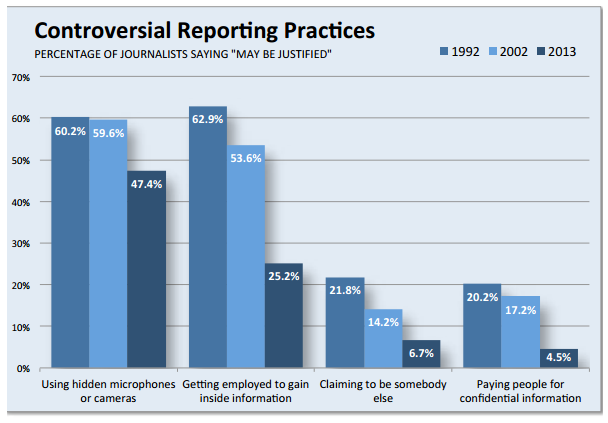
Journalists in 1992 basically had no ethical code. Or, if they did have an ethical code, it was buried under their aggressively extra-legal instincts to get information by bribes, lies, and hidden microphones. More than 60 percent of journalists said it would be fine to get a job simply to expose the company (the '90s would have loved Edward Snowden) and 20 percent said they were fine with lying to sources or bribing them. Today, we're either more moral, less dedicated to The Truth, more scared of getting caught, or some combination of the three.